
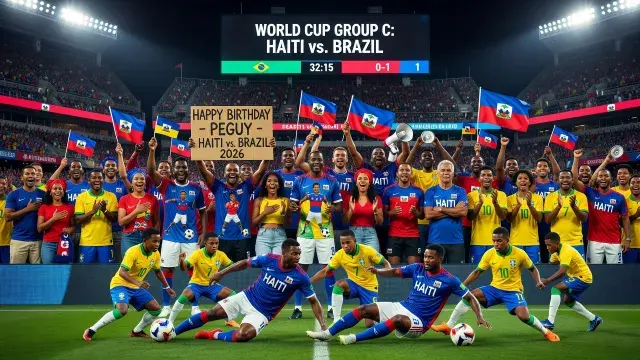
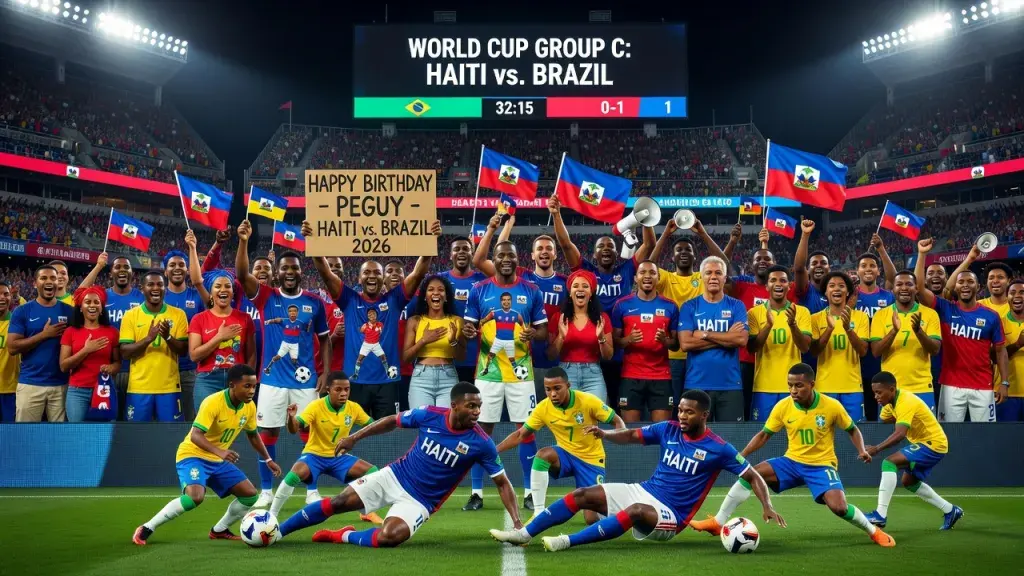
When Peguy Joseph takes his seat in Philadelphia on Friday, he will do something he has never done before in his life: he will not be cheering for Brazil. A lifelong Seleção fanatic, Joseph - like hundreds of thousands of Haitians across the United States and beyond - finds himself caught between two loves as Haiti face the five-time world champions in one of the most emotionally charged group-stage fixtures this World Cup has served up. "It's a double joy," said Joseph, who is travelling from Florida to attend the game for his birthday. "I'll be happy if Haiti win - but if Haiti lose, I won't be sad, because it's Brazil. It's the fanaticism. When you love it, you love it."
The matchup sits in Group C alongside Morocco and Scotland, and on paper it could scarcely be more lopsided: Brazil ranked sixth in the world, Haiti 84th, with the Grenadiers listed as roughly 30/1 underdogs. The emotional stakes, however, are immeasurable and entirely separate from the sporting arithmetic. For the Haitian diaspora in the U.S., the days leading up to kick-off have carried an intensity that goes well beyond football - much like the build-up to a major combat sports night where fans scan bkfc odds tonight trying to figure out if the underdog really has a puncher's chance. Here, there is no algorithm for what Haiti mean to their own people simply by being on that pitch. bkfc odds tonight
A Nation Qualifies Against the Odds
Haiti's presence at this World Cup is itself a story of extraordinary resilience. The Grenadiers had not appeared at the tournament since 1974, and their path back was anything but straightforward. Armed gangs control large swathes of Port-au-Prince, including the area around the national stadium, forcing Haiti to stage their "home" qualifying fixtures on the Caribbean island of Curaçao - playing in near-silence, without their own fanbase behind them. That they qualified at all, defeating better-resourced rivals along the way, speaks to a stubborn collective will that resonates far beyond football. "It's almost like David and Goliath - we're going up against a giant, a huge soccer giant," said Rachelle Leger, a Haitian-American community leader in Philadelphia.
Decades of Yellow Jerseys and Shared Identity
The depth of Haitian affection for Brazil is not a casual thing. It is woven into the fabric of everyday life in Port-au-Prince, where the brightly painted minibuses known as tap-taps have long carried images of Brazilian legends - Romario, Ronaldo, Neymar - alongside religious iconography and national pride. Haitians grew up wearing the yellow Seleção shirt as naturally as their own colours, flooding the capital's streets to celebrate Brazilian World Cup victories as communal moments of joy. Many trace the bond to a shared history - the legacy of slavery, the African cultural roots that run through both nations, and the visibility of Black Brazilian players from Pelé onwards providing representation that felt personal. "Brazil feels like a sister country, very similar with culture," said Joel Jean-Baptiste, a Haitian-American who canceled a planned family holiday to Europe the moment he learned Haiti would face Brazil at this tournament. "We look in the field, and we see people who look like us, doing great things."
That connection deepened further in 2004, when Brazil led a United Nations peacekeeping mission in Haiti and organised a friendly in Port-au-Prince to promote peace following the turbulent ousting of President Jean-Bertrand Aristide. Thousands of Haitians lined the roads from the airport to the stadium, chanting for Brazil as an armoured convoy carried Ronaldo, Roberto Carlos and other Seleção greats into the city. Haiti lost that match 6-0. Their fans waved Brazilian flags throughout. After the catastrophic 2010 earthquake, significant numbers of Haitians resettled in Brazil, tightening the human ties between the two nations still further.
A Miracle Already Written Into History
Brazilian Rafael Saldanha, watching from New York with a ticket in hand, framed the fixture with warmth rather than rivalry. "I was happy when I learned Brazil's going to play Haiti, because I know these are two very friendly nations to each other," he said. "Both are nations that have their own internal struggles. But these are two countries whose populations manage to be extremely happy, regardless, or in spite, of the challenges posed on them every day." That shared resilience is part of what makes the fixture so charged with meaning beyond sport. Haitian communities in the U.S. are simultaneously navigating the uncertainty of the Trump administration's efforts to end temporary protected status for tens of thousands of Haitian residents - a pressure that makes the collective release of this World Cup moment feel all the more significant.
Kirk Bowman, a professor at Georgia Tech who teaches Soccer and Global Politics and has written on the sport's global reach, cautions against writing Haiti's chances off entirely on the grounds of footballing logic alone. He points to the FA Cup upset earlier this year when sixth-tier Macclesfield eliminated Premier League side Crystal Palace, and to a far older and more personal piece of Haitian football history. At the 1950 World Cup in Brazil, a part-time U.S. side featuring factory workers, a mailman and a hearse driver defeated England 1-0. The goal was a header from Joe Gaetjens - a Haitian dishwasher and amateur player based in New York. He was carried from the pitch by celebrating Brazilian supporters. Gaetjens returned to Haiti, where he was killed in 1964 under the Duvalier dictatorship, but his place in the sport's lore is permanent. "Haiti can believe in another Haitian 'miracle on grass,'" Bowman said. "A Haitian already had one."


