
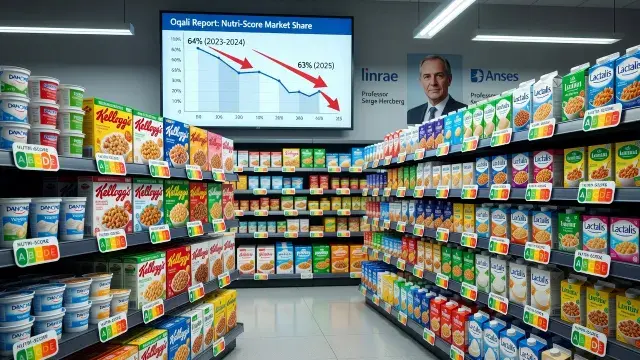
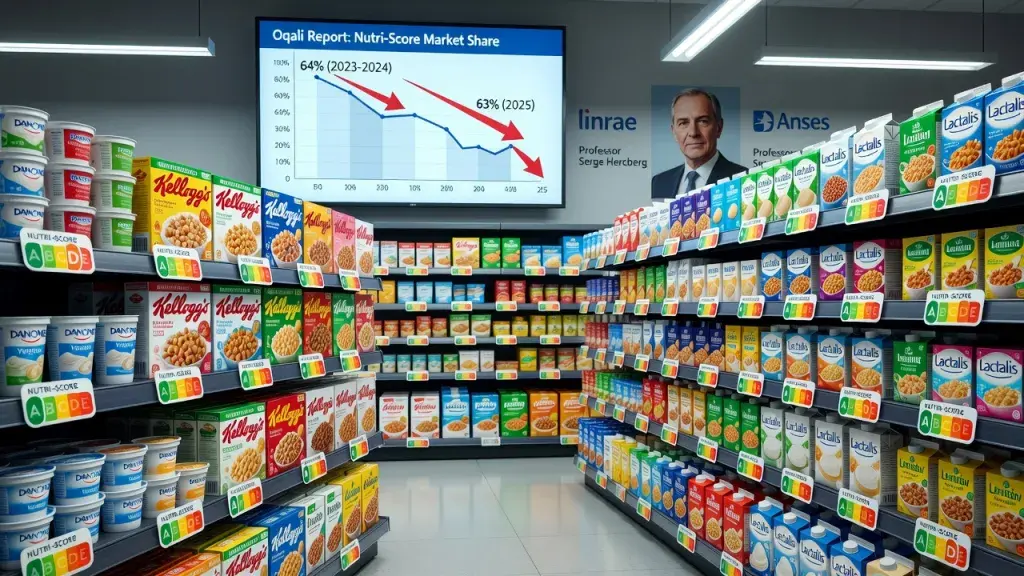
The volume of products carrying the Nutri-Score nutritional label has declined for the first time, France's food observatory Oqali reported on Wednesday, marking a significant setback for a scheme that had grown steadily since its launch. The retreat is driven primarily by the withdrawal of major national brands from the voluntary labelling system, raising fresh questions about its long-term viability without a legal mandate to enforce it.
According to Oqali, which is jointly overseen by research institute Inrae and health authority Anses, the market share of products bearing the Nutri-Score slipped from 64% of sales volumes in 2023 and 2024 to 63% in 2025, across supermarkets and specialist retail channels. While that one-percentage-point drop may appear modest in isolation, it breaks a run of continuous year-on-year growth and is the first backward movement the observatory has recorded since it began tracking the scheme. The report also noted that, much like the niche but growing world of beach volleyball online betting, specialist channels are proving surprisingly dynamic: organic and health-focused retailers surged from just 1% to 11% of Nutri-Score market share in a single year, a remarkable leap that signals genuine appetite for transparent nutritional information in those segments.
The Nutri-Score system grades food products on a scale from A to E, giving consumers a quick visual tool to compare the nutritional quality of items within the same food category. The label is voluntary in France and across several other European countries, and multiple attempts to make it compulsory have failed in recent months, leaving its reach entirely dependent on corporate buy-in.
Danone, Kellogg's and the Weight of Brand Withdrawals
The numbers behind the decline point clearly to a handful of heavyweight departures. From September 2024, Danone began removing the Nutri-Score from certain products, including yoghurts - a significant move given the company's dominance in the fresh dairy and desserts segment. That sector, along with breakfast cereals, is specifically identified by Oqali as one of the key areas where national brand disengagement has driven the overall retreat.
In May, Professor Serge Hercberg, the nutritionist who co-created the Nutri-Score, publicly expressed concern that Kellogg's had "quietly" dropped the label from certain products following an update to the scoring algorithm. That update was designed to reward fibre-rich foods more generously while penalising products high in sugar and salt more heavily - changes that logically disadvantage some processed food ranges that had previously scored well. Lactalis, one of the world's largest dairy groups, has never adopted the Nutri-Score at all.
By June 2025, a total of 1,462 companies were registered in the Nutri-Score scheme, up from 1,377 a year earlier. The raw number of participating businesses is growing, but the new entrants are mostly smaller operators whose combined market weight cannot offset the commercial footprint of the major brands that have stepped back. That structural imbalance is precisely what makes the market share figure the more telling indicator.
Private Labels Hold Firm, But National Brands Are the Real Test
Oqali draws a clear distinction between the behaviour of retailer own-label brands and that of national manufacturers. Supermarket private labels have remained almost universally committed to the scheme for several years and continue to display the label consistently. It is the national brands - the household names that command the largest shelf space and the broadest consumer reach - where the problem is crystallising.
The observatory reports that national brand engagement has slipped from 39% to 37% between 2024 and 2025, a decline it describes as both a stagnation and a retreat. In its communiqué, Oqali frames the mobilisation of national brands as the defining challenge for the years ahead. Without their participation, the scheme's coverage will continue to erode regardless of how many small or medium-sized producers sign up.
This is also the first occasion on which Oqali has communicated publicly about its monitoring findings - itself a signal that the organisation considers the current trajectory worth flagging to policymakers and consumers alike. With mandatory labelling still off the legislative table for now, the pressure falls on regulators, public health advocates, and industry stakeholders to find a path that keeps major manufacturers engaged with a system that, for all its political friction, remains one of the most consumer-friendly nutritional tools in European food retail.


