The market for virtual gaming assets is worth billions of dollars globally, and a significant portion of that value flows through the trading of game accounts. Players exchange accounts representing thousands of hours of progress, rare cosmetic items, and competitive rankings - all for real money, every single day. This is not a fringe activity. It is a structured, high-volume economy operating across dozens of platforms and covering hundreds of games.
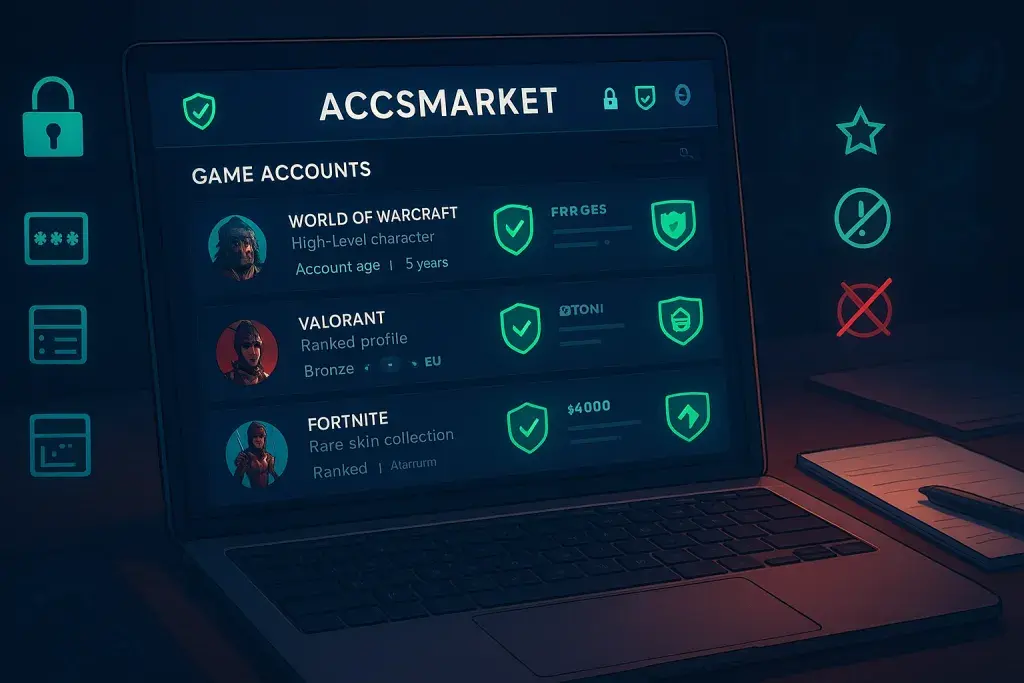
Whether you have spent years building a powerful account you no longer use, or you want to enter a game at a competitive level without enduring months of grinding, the secondary market offers a direct solution. Platforms dedicated to this purpose have matured considerably - you can now sell game accounts through organized marketplaces like sell game accounts on Accsmarket, where listings are structured, buyers are verified, and transactions are tracked from start to finish.
The challenge is that this market also attracts fraud. Scammers exploit inexperienced buyers, dishonest sellers recover accounts after payment, and poorly designed platforms leave both parties with no recourse. The gap between a smooth transaction and a costly mistake often comes down to knowing what to look for. This guide walks through every stage of the process - from understanding the market to completing a trade securely - so you can participate with confidence rather than guesswork.
What Is Game Account Trading and Why Is It So Popular?
Game account trading refers to the buying and selling of established player accounts between individuals, typically for monetary payment. Unlike purchasing in-game currency or cosmetic items through official store channels, account trading involves transferring full ownership of a profile - including its level, rank, unlocked content, and linked history - from one person to another.
This practice exists because progress in many games is time-intensive, and the gap between a new account and a fully developed one can represent hundreds of hours of play. For many people, purchasing an account is simply a practical decision: they want to experience high-level content, compete at a specific tier, or collect rare items that are no longer obtainable through normal gameplay.
Why Buyers Want Pre-Leveled or Rare Accounts
The appeal of buying an established account varies depending on the player's goals, but several motivations appear consistently across the market. Competitive players frequently want to enter ranked modes at a level that reflects their actual skill, rather than spending weeks on placement matches with a fresh account. Collectors seek accounts with limited-edition skins, legacy items, or event rewards that were only available during specific periods and cannot be earned again. Returning players who lost access to their original account sometimes purchase a replacement rather than starting completely over.
In games like World of Warcraft, reaching the level cap with a fully geared character can take months of consistent play. In games like Valorant or League of Legends, a ranked account with a strong win rate has tangible competitive value. In Fortnite, accounts holding rare skins from early seasons are treated almost like collectibles, with prices reflecting their scarcity rather than any in-game advantage.
- Skipping lengthy progression phases to access end-game content immediately
- Obtaining rare or discontinued cosmetic items no longer available through gameplay
- Entering competitive ranked modes at a higher starting point
- Replacing a lost or banned personal account with an equivalent alternative
- Collecting high-value accounts as digital assets
Why Sellers Want to Cash Out Their Accounts
Sellers are typically players who have moved on from a game and want to recover some value from the time they invested. Quitting a title after years of play and simply abandoning an account feels wasteful when someone else would pay real money for what has been built. Others sell because they are switching games entirely, because they want to fund purchases in a different title, or because they have deliberately built accounts with the intention of selling them.
A smaller but active segment of the market consists of traders who treat account flipping as a systematic activity - purchasing underpriced accounts, improving them through play, and reselling at a higher value. This requires knowledge of which games have active secondary markets and what factors drive account prices.
How Large Is the Online Game Account Sales Market?
The broader virtual goods market - which includes in-game purchases, digital item sales, and account trading - is substantial and continues to grow alongside the gaming industry itself. Online game account sales represent a meaningful slice of this economy, with dedicated marketplaces processing a large volume of transactions daily across popular titles. The most active categories include massively multiplayer online games, competitive shooters, mobile RPGs, and battle royale titles.
Market activity is not evenly distributed. A handful of games account for the majority of account trading volume, driven by large player bases, significant time investment requirements, and strong demand for rare or high-ranked profiles. The relative value of an account is shaped by the game's popularity, the rarity of its contents, server region, and current competitive season.
| Perspective | Main Motivation | Typical Account Type Sought |
|---|---|---|
| Buyer | Save time, access rare content, compete at higher level | High-rank, fully leveled, or rare-item accounts |
| Seller | Monetize unused progress, fund other purchases, exit a game | Well-developed accounts with strong history or rare assets |
Understanding the Risks Before You Buy or Sell
Game account trading operates in a space where real money changes hands for digital goods that have no standardized legal protection. Before placing a listing or making a purchase, every participant should understand the two primary categories of risk: platform-level consequences tied to game publisher policies, and transactional risks tied to fraud. Conflating these two categories leads to poor decisions. They are distinct problems that require different responses.
Terms of Service and Platform Bans - What You Need to Know
The majority of major game publishers prohibit account trading in their Terms of Service. This means that if an account is flagged for having changed ownership, the publisher has the right to suspend or permanently ban it without issuing a refund. The key point here is that violating a Terms of Service agreement is a contractual matter between the player and the publisher - it is not a criminal offense in most jurisdictions. Buying or selling a game account is generally legal as a transaction, but it carries the risk of losing access to the account if the publisher detects and acts on it.
Enforcement varies considerably. Some publishers, including Riot Games, the developer behind Valorant and League of Legends, have historically taken an active stance against account trading and have systems in place to detect unusual login behavior. Others, particularly older MMORPGs or mobile games with less sophisticated monitoring, may rarely act on account transfers. The practical advice here is specific: before buying or selling any account, research how aggressively that game's publisher enforces its Terms of Service. Community forums, Reddit threads, and player discussions will often give you a reliable picture of the current enforcement climate.
Common Scams Targeting Buyers
Buyers face a wider variety of fraud types than sellers do, largely because they are the party delivering payment. The most frequent scam involves a seller providing login credentials that appear to work at first, only to recover the account by contacting the game's support team and claiming the account was stolen. Because the original owner often has verifiable proof of account creation - original email address, payment records, security questions - support teams frequently side with them, leaving the buyer locked out.
Other scams targeting buyers include:
- Fake listings where the account does not match the screenshots or description provided
- Sellers who disappear after payment without delivering any credentials
- Phishing links disguised as account verification pages that capture the buyer's own login data
- Impersonators who clone legitimate seller profiles on less-regulated platforms
- Accounts that are already flagged or under review by the publisher, making them unusable shortly after purchase
- Inflated item descriptions - listing common items as rare or overstating account rank
Common Scams Targeting Sellers
Sellers are not immune to fraud. Chargeback scams are a serious and recurring problem: a buyer pays via a reversible payment method, receives the account credentials, and then files a dispute with their bank or payment provider claiming the transaction was unauthorized. The payment is reversed, and the seller has lost both the account and the money. This is particularly common when sellers agree to accept PayPal Friends and Family payments or direct bank transfers outside of a protected platform.
Sellers also face account recovery attempts from buyers acting in bad faith - receiving credentials, immediately attempting to lock out the original seller, and then reselling the account themselves. Fake payment confirmation screenshots are another known tactic, where a buyer sends a doctored image showing a completed transfer that never actually occurred.
- Chargeback fraud using reversible payment methods after receiving account access
- Fake payment confirmations designed to trick sellers into handing over credentials prematurely
- Buyers who claim the account was not as described and demand a refund while keeping access
- Overpayment scams where a buyer sends excess funds and asks for a partial return before the original payment clears
| Payment Method | Buyer Protection | Seller Protection | Risk Level |
|---|---|---|---|
| Platform escrow system | High | High | Low |
| Credit card via protected checkout | Medium | Medium | Medium |
| PayPal Goods and Services | Medium | Low | Medium-High |
| PayPal Friends and Family | None | None | Very High |
| Direct bank transfer | None | Low | Very High |
| Cryptocurrency without escrow | None | None | Very High |
Warning: Never complete a game account transaction outside of an escrow-protected platform or a payment method with built-in dispute resolution. Doing so removes all practical recourse if something goes wrong.
How to Choose a Trustworthy Gaming Account Marketplace
The platform where you trade matters more than almost any other factor. A well-designed gaming account marketplace provides structural safeguards that protect both parties - escrow systems, seller verification, dispute resolution, and transparent review histories. A poorly designed or outright fraudulent platform provides none of these, regardless of how professional it looks on the surface. Choosing where to trade is the single most consequential decision in the entire process.
Key Features of a Legitimate Marketplace
Legitimate platforms share a consistent set of characteristics. The most important is an escrow payment system: the buyer's funds are held by the platform and only released to the seller once the buyer confirms they have received and verified the account. This single feature eliminates the majority of fraud scenarios for both parties. Without it, neither side has any enforceable protection.
Beyond escrow, trustworthy platforms include:
- Seller identity verification or reputation scoring based on completed transaction history
- A formal dispute resolution process with a designated support team
- Secure, encrypted payment processing through established payment providers
- Buyer and seller review systems that are verified rather than self-reported
- Clear policies on what happens when a transaction is disputed
- Transparent fee structures with no hidden charges revealed at checkout
- Accessible customer support with documented response times
Red Flags That Signal an Unreliable Platform
Some warning signs are obvious; others require closer inspection. A platform that accepts payment only via cryptocurrency or wire transfer with no escrow mechanism is structured to favor fraud. No payment method that benefits the seller unconditionally is appropriate for a marketplace handling high-value transactions.
Watch for these indicators of an unreliable platform:
- No HTTPS encryption on the site or checkout pages
- No verifiable company information, physical address, or registered business identity
- Seller reviews that cannot be traced to verified completed transactions
- No written dispute resolution policy or no way to contact support
- Pressure to complete payment quickly or outside the platform's own system
- Listings that seem uniformly too cheap across all categories
- No refund or guarantee policy of any kind
Practical tip: Before registering on any platform, search for its name alongside terms like "scam," "review," or "complaint" in gaming communities. Reddit threads, Discord servers, and gaming forums often surface credible user experiences that a platform's own marketing will not mention.
Types of Marketplaces - Which Model Is Safest?
Not all platforms operate the same way. Understanding the structural differences between marketplace models helps you evaluate where to spend and where to list.
| Marketplace Type | Description | Buyer Protection | Seller Protection | Risk Level |
|---|---|---|---|---|
| Dedicated account marketplace | Purpose-built platform for buying and selling accounts, with escrow and verification | High | High | Low |
| General digital goods marketplace | Broader platforms that include accounts among many product types | Medium | Medium | Medium |
| Forum or community trading | Trades arranged on Reddit, Discord, or game-specific forums | Low | Low | High |
| Social media direct trading | Transactions arranged through DMs on social platforms with no oversight | None | None | Very High |
Dedicated gaming account marketplaces offer the most protection because they are built specifically for this transaction type. They understand the fraud patterns involved, have dispute resolution staff familiar with account trading, and their escrow systems are designed around the specific logistics of credential transfer. General digital goods platforms provide moderate protection but may lack the domain-specific expertise to handle account recovery disputes effectively. Community forums and social media direct trades carry the highest risk and should be avoided unless you have an established, verifiable trust history with the specific counterparty.
Step-by-Step Guide to Buying a Game Account Safely
Buying a game account safely is a process, not a single decision. Each stage of the transaction carries its own risks, and skipping steps - even when a seller seems trustworthy - is how most buyers end up in disputes. The following process applies to purchases made on legitimate platforms with escrow protection in place.
How to Search and Filter Listings Effectively
Most established marketplaces provide filtering tools that let you narrow listings by game, server region, account level or rank, specific included items, and price range. Use these filters precisely. A listing that broadly claims "high-level account" without specifying the character class, server, or exact rank is a poor candidate - not necessarily fraudulent, but insufficiently detailed to evaluate fairly.
When searching, prioritize listings that include:
- Specific rank or level with screenshots taken at the time of listing
- Server region clearly stated, especially for region-locked games
- Complete item or skin inventory, ideally shown through in-game screenshots
- Account age and the presence or absence of any prior suspensions or warnings
- A clear statement of what is and is not included in the transfer
Compare multiple listings for the same account type before committing. If a price is significantly lower than comparable listings, treat that as a signal requiring deeper investigation, not an opportunity.
How to Evaluate a Seller Before Paying
Seller credibility should be assessed through observable data, not impressions. Check the seller's transaction history on the platform - how many completed sales they have, what their average rating is, and whether any disputes have been filed against them. A new seller with zero completed transactions is not automatically fraudulent, but the risk profile is higher and should be reflected in your willingness to pay a premium price.
Before purchasing, ask the seller direct, specific questions. Vague or evasive answers are informative. Ask them to provide:
- A current screenshot showing the account's login screen and profile summary
- Confirmation that no linked recovery options remain tied to a previous owner's personal information
- Clarification on whether the account has ever been suspended or warned
- The original email address format associated with the account (not necessarily the address itself) to confirm they control it
Sellers who cannot answer these questions specifically and promptly should not receive payment.
Secure Payment - Using Escrow and Protected Methods
Pay only through the platform's own payment system. If a seller asks you to pay via a separate method - cryptocurrency sent directly to a wallet, a bank transfer, or a payment app - decline. This request is the most reliable single indicator that something is wrong. Legitimate sellers on legitimate platforms have no reason to move the transaction off-platform.
Escrow works by holding your payment until you confirm receipt of the account and verify that it matches the listing. Only then are the funds released to the seller. This gives you a defined window to inspect what you have purchased without the seller being able to disappear with your money. Understand the escrow terms on whichever platform you use: how long the inspection window lasts, what triggers automatic fund release, and how to pause the process if something is wrong.
What to Do After Receiving Account Credentials
The moment you receive login credentials, begin verification immediately - do not wait. Escrow inspection windows are time-limited, and your ability to dispute rests on acting within that period.
- Log in and confirm the account matches the listing in rank, level, items, and server region
- Change the account password immediately to one the previous owner cannot know
- Update the linked email address to one you control exclusively
- Enable two-factor authentication using your own phone number or authenticator app
- Remove any recovery options tied to the previous owner's information
- Take screenshots of the account's current state as documentation
- Confirm receipt through the platform only after all of the above steps are completed and verified
Do not confirm receipt before fully verifying the account. Once you release escrow, the transaction is typically considered complete and reversing it becomes significantly harder.
Step-by-Step Guide to Selling a Game Account Safely
Selling a game account is a different set of challenges than buying one. The seller carries the risk of non-payment or chargeback fraud, and also bears responsibility for ensuring the account is cleanly transferred without any personal information remaining attached. A careless seller creates problems for themselves long after the transaction closes.
How to Price Your Account Accurately
Pricing is a research task, not a guess. Browse active listings on your chosen platform for accounts comparable to yours - same game, similar rank or level, equivalent item inventory, same server region. Note the prices at which accounts are actually selling, not just listed. Listing price and transaction price are not always the same, and overpricing relative to the market leads to your listing sitting unsold while others move.
Key factors that affect account value include:
- Rank or level relative to the current competitive season
- Presence of limited-edition, legacy, or discontinued cosmetic items
- Account age and unbroken standing history
- Server region and its demand in the buyer market
- Game popularity at the time of sale - values shift with active player counts
- Whether the account includes rare achievements, titles, or unlocks with documented proof
Be realistic about pricing. An account with a high rank in a declining game trades at lower value than a moderately ranked account in a game at peak popularity.
Writing a Listing That Builds Buyer Trust
A well-written listing is specific, honest, and visually supported. Buyers who see vague descriptions skip past them because specificity signals that a seller actually has what they are offering. A listing that says "high-level Diablo IV character, great items" tells a buyer almost nothing. A listing that specifies the class, Paragon level, gear score, season, and server with accompanying screenshots tells a buyer exactly what they are considering.
Your listing should include:
- Game title and server region
- Exact level, rank, or progression milestone
- Complete inventory of notable items, skins, or unlocks
- Account age and current standing (no active bans or warnings)
- Transfer method and timeline
- Screenshots dated at or near the listing date, not weeks old
- A clear statement of what the buyer will and will not receive
Honesty in listings protects you. A buyer who discovers that listed items were misrepresented will file a dispute, and disputes resolved against the seller damage both reputation scores and earnings.
Secure Transfer Methods and Protecting Against Recovery Scams
The most important step in any account sale is the clean transfer - fully disassociating your personal information from the account before or during handover. If a buyer can contact game support and have the account returned to you based on your original ownership data, the sale is not complete. More importantly, if you retain access to recovery options after selling, you face a legal and ethical obligation not to use them - and the temptation to do so represents serious risk to your standing on the platform.
Before transferring credentials:
- Change the linked email address to a neutral one created specifically for the transfer, not your personal address
- Remove your phone number from account recovery settings
- Clear any linked payment methods that could be used to verify original ownership
- Remove connected social media accounts or third-party logins
- Change the security questions and answers if the game uses them
- Provide the buyer with all credentials for the transfer email address, not just the game account itself
Warning: Attempting to recover an account after selling it constitutes fraud. Platforms track account recovery attempts and will ban sellers who engage in this behavior. In some jurisdictions, it may also expose the seller to civil liability.
Confirming the Sale and Withdrawing Funds Safely
Once you have transferred credentials and the buyer has had time to verify the account, the platform's escrow system will release funds upon buyer confirmation. Do not pressure buyers to confirm immediately - doing so often triggers suspicion and can delay the process. A buyer who needs a reasonable amount of time to verify a complex account is behaving normally.
After funds are released, withdraw to a method you have verified with the platform. Keep a record of the transaction - platform confirmation, transaction ID, and any communication with the buyer - for at least 30 days in case a delayed dispute arises. Most legitimate platforms have a defined window after which closed transactions cannot be reopened, but retaining documentation costs nothing and protects you if one is.
Protecting Yourself After the Transaction Is Complete
Most guides end at the point of transaction confirmation. In practice, some of the most consequential steps happen afterward. Both buyers and sellers have actions to take once funds are released, and skipping them leaves unnecessary exposure.
For buyers, the post-purchase security checklist should be treated as non-negotiable:
- Verify that two-factor authentication is active and tied to your own devices only
- Confirm no previous owner's email or phone number appears in the account's recovery settings
- Check connected devices in the account's security settings and remove any unfamiliar sessions
- Do not share the new credentials with anyone, even temporarily - any access given to others complicates disputes if issues arise later
- Save a copy of all transaction communications, screenshots, and the platform's transaction record
For sellers, closing a transaction cleanly means:
- Confirming that the transfer email address created for the sale is no longer accessible to you
- Deleting any local copies of the account credentials you transferred
- Saving your platform transaction record and any buyer communications for your own records
- Monitoring your seller account for any delayed dispute notifications over the following days
Escrow release marks the financial close of a transaction, but it does not necessarily mean all risk has passed. A buyer who discovers a problem within the platform's post-close dispute window may still file a claim. Thorough documentation on both sides is the best protection against an unresolved dispute becoming a financial loss.
Tips for Becoming a Successful Long-Term Account Trader
Participating in buy and sell accounts activity once is a learning experience. Doing it repeatedly, profitably, and without incident requires a more deliberate approach. Whether you are building a seller reputation or making regular purchases, consistency and platform knowledge separate successful traders from frustrated ones.
Building a strong seller reputation takes time but compounds quickly. Buyers search specifically for verified, high-rated sellers when making significant purchases, and a seller with fifty positive reviews and zero disputes commands a price premium over an unknown listing at the same specification. Actions that accelerate reputation growth include responding to buyer inquiries promptly, delivering credentials within the stated timeline, providing accurate and detailed listings every time, and offering a brief post-sale availability window for buyers who encounter minor technical questions during account setup.
For traders who want to engage in account flipping - buying accounts to improve and resell - timing matters considerably. Account values often rise around competitive season launches, major game updates that add new content, or limited-time events that make certain in-game items temporarily available. Buying accounts with strong foundations ahead of these periods and selling during peak activity can yield meaningful returns, though this requires close attention to each game's development calendar.
Games with consistently active secondary markets tend to share a few characteristics: large established player bases, content that takes meaningful time to unlock, and a community that values account status as a social signal. Monitoring which titles retain strong trading volume over time - rather than chasing short-lived hype - is the difference between a sustainable trading approach and one that depends on lucky timing.
- Respond to buyer inquiries within a few hours - faster response correlates with higher close rates
- Keep listings updated; outdated screenshots erode buyer confidence immediately
- Track seasonal events in active games and time listings to align with peak demand
- Diversify across two or three games rather than depending entirely on one title's market
- Reinvest earnings from sales into accounts with stronger value drivers, rather than immediately withdrawing all profit
- Build familiarity with each platform's fee structure so margin calculations are accurate before listing
One practical distinction worth understanding: a seller who transacts occasionally and a trader who operates systematically have different needs from a platform. Casual sellers benefit most from ease of listing and reliable buyer traffic. Active traders benefit more from lower transaction fees, bulk listing tools, and detailed sales analytics if the platform provides them. Choosing a marketplace that matches your actual transaction volume avoids paying for features you do not use or missing tools you need.
Questions and Answers
If I buy an account and the original owner recovers it, can I get my money back?
If you purchased through a platform with escrow, you should open a dispute immediately and provide documentation: transaction records, screenshots of the account contents you received, and evidence that access was lost. Reputable marketplaces have dispute resolution processes specifically for this scenario. If you paid outside of escrow - directly to a seller - recovery is significantly harder and depends entirely on the payment method used. This is why escrow-protected platforms are essential, not optional.
Does buying a game account on a marketplace guarantee the account won't be banned by the publisher?
No legitimate marketplace can guarantee a publisher will not act on a traded account. Marketplaces protect the transaction between buyer and seller; they cannot control what game publishers do with accounts that violate their Terms of Service. The risk of a publisher-side ban exists for virtually all traded accounts, and buyers should factor this into their decision. Research the publisher's enforcement track record for the specific game before purchasing.
What should I do if a seller asks me to verify the account by logging in before paying?
Do not log in to verify an account before payment is secured in escrow. Some fraudulent sellers use this request to capture your IP address or to get you to interact with a phishing page disguised as a login portal. Verification should happen after payment is held in escrow - never before. If a seller insists on pre-payment verification, treat it as a red flag and walk away from the listing.
How do I know if the price a seller is asking for an account is fair?
Compare the listing against at least five to ten comparable accounts on the same platform and on competing marketplaces. Look at completed sales rather than just active listings, since asking prices do not always reflect what buyers actually pay. Accounts priced significantly below market rate often indicate misrepresented contents, a compromised account, or a seller attempting to move inventory quickly before a problem surfaces. Match the price to the documented contents, not to the seller's claims alone.
Can I sell an account that I originally purchased from someone else?
Yes, in most cases you can resell a purchased account on a gaming account marketplace, provided you have full control of all account credentials and recovery options. The buyer needs to be able to take complete ownership, which means all previous ownership traces must be removed before the transfer. The same risks apply as with any account sale - publisher Terms of Service, account recovery risks, and the need for a secure platform - regardless of whether you were the original creator of the account.
Is there a way to check if a game account has an existing ban or restriction before buying it?
The most direct method is to ask the seller for proof of current account standing, which reputable sellers can provide through in-game screenshots or account status pages. Some games display account status publicly through official tools - for example, certain publishers provide ban-check pages where you can enter a username or ID. Beyond that, request confirmation that the account has no active or pending warnings through the platform's messaging system, creating a documented record. If the seller refuses or cannot demonstrate clean standing, do not proceed with the purchase.